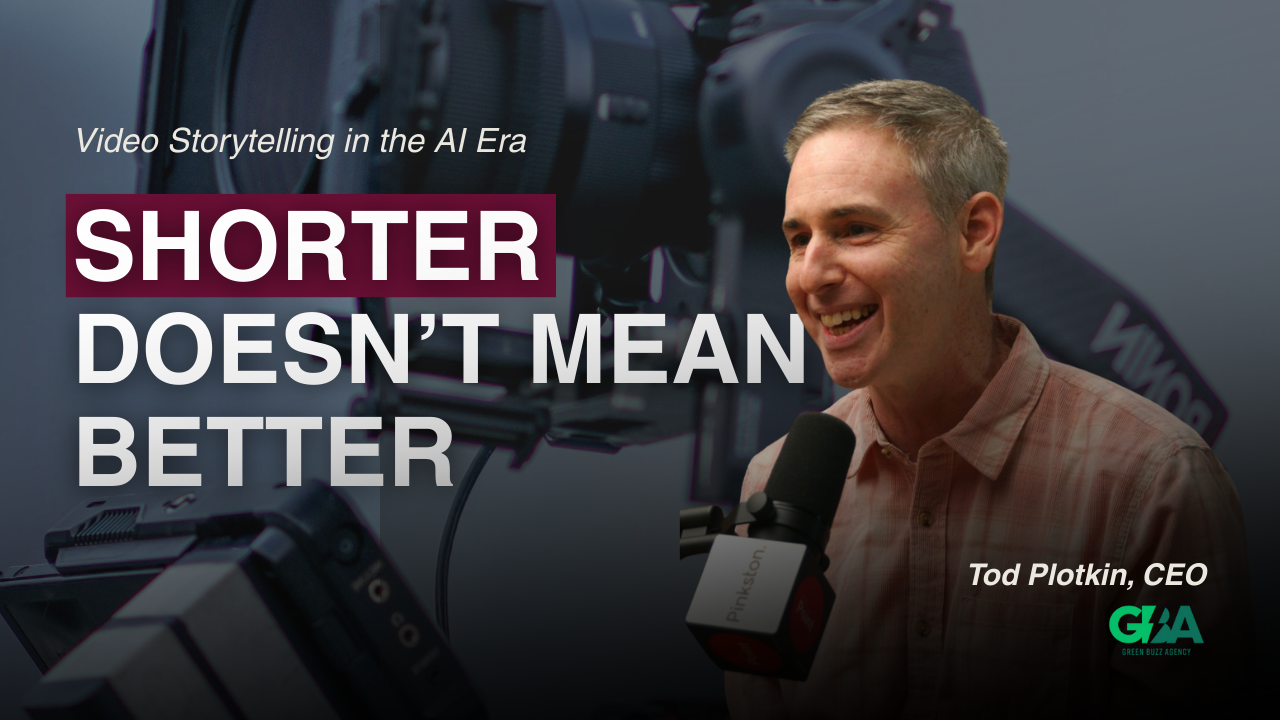
In the latest episode of Pinkston’s “To The Point” podcast, Tod Plotkin, CEO of Green Buzz Agency, sat down with host Zach Crenshaw to discuss how technology, AI, and changing audience expectations are reshaping video storytelling. Their conversation traced Plotkin’s journey from struggling founder to industry leader, and unpacked what brands and creators need to know to thrive in this new era.
Plotkin’s path was not a straight line: an early, niche sports-video venture failed, sending him back into established organizations like The Washington Post and the Washington Wizards to build his skills and learn how content and business really work. Years later, he used those lessons to relaunch and grow Green Buzz into an award‑winning agency.
From Failure to Foundation
Plotkin’s first entrepreneurial venture focused on a narrow niche: youth sports highlight reels to help high school athletes earn college scholarships. It was a niche within a niche, and the business ultimately didn’t work. Instead of abandoning video altogether, he treated the failure as a signal that he needed more “seasoning” in both production and business.
That led him to roles at a local production company, The Washington Post, and the Washington Wizards. In each stop, he studied what worked, what didn’t, and why—across creative, operations, and audience engagement. When he finally launched Green Buzz Agency in earnest in 2010, he wasn’t just a shooter or editor; he was a strategist who understood budgets, stakeholders, and the realities of corporate decision‑making.
The First Great Shift in Video
Long before AI, Plotkin witnessed a different technological earthquake: the democratization of professional tools between roughly 2008 and 2013. At that time, high‑end cameras cost around 250,000 dollars, and editing suites could run 110,000 dollars each. A whole post‑production bay represented millions in capital, effectively gatekeeping serious video work for large studios and agencies.
In a few short years, that model collapsed. Cameras dropped to a few thousand dollars. A 2,000‑dollar laptop and a 1,000‑dollar software license suddenly did what a six‑figure edit suite used to do. With that change, an entrepreneurial creative could build a functional studio for $10,000–$15,000 instead of millions. Plotkin credits this era with making his own agency possible—and with opening the door for today’s wave of independent content creators.
The Second Wave: AI and the New Baseline
Today, Plotkin sees AI as the next significant shift, but he is careful to distinguish how it hits different parts of the industry. For agencies like Green Buzz, which focus on real people and human‑centric stories, AI imagery and tools are a powerful supplement. They can integrate beautiful, thematic visuals around a Make‑A‑Wish wish‑granting story without incurring the costs of additional crews, travel, or complex stock licensing.
On the other hand, he notes that high‑budget commercial work built largely on glossy, cinematic imagery has more to fear. When AI can plausibly replicate a car commercial’s sweeping mountain drone shots, a brand may question why it needs to fund a 500,000‑ to 2‑million‑dollar shoot. Plotkin has heard the nervousness firsthand from advertising executives who are being forced to rethink their pricing models and production assumptions.
Pricing, Thresholds, and Content Creators
One of Plotkin’s recurring themes is the danger of clinging to old pricing thresholds. He recalls a time when agencies insisted that nothing meaningful could be produced for less than six figures, claiming the “logistics alone” made smaller budgets impossible. In hindsight, that rigidity looks absurd—and he sees similar patterns today.
Modern content creators are eager to offer packages like “10 videos for 8,000 dollars,” while some established production companies still refuse to take on work under 12,000–15,000 dollars per video. Meanwhile, many clients now use smaller 5,000–10,000‑dollar projects as test runs to evaluate an agency’s quality, communication, and reliability before awarding larger contracts. In Plotkin’s view, agencies that refuse to operate at these entry levels are ceding ground to more agile competitors who are happy to prove themselves and scale with the client.
The Myth That “Everything Must Be Short”
If there’s a single misconception Plotkin would like to puncture in marketing circles, it’s the notion that every video must be short. He traces how ideas such as “all videos should be under a minute,” “everything must be raw and authentic,” and “influencers should make all content” spread through conferences, podcasts, and peer conversations, until they harden into unquestioned rules.
Reality, he argues, is more nuanced. Platforms like Netflix prove there is still a massive appetite for long‑form storytelling. YouTube’s most successful podcasts stretch into hours. For organizations with deeply invested audiences—such as universities with loyal alumni—those “power users” will happily watch a three-, five-, or seven-minute video if it speaks directly to their connection and values. The problem isn’t length; it’s matching the story and audience to the correct format and distribution strategy.
Finding the Right Length for the Story
Plotkin’s point is not that videos should be long, but that every story has an ideal length—and that ideal is not always 30 or 60 seconds. He encourages marketers to decouple two critical questions: how quickly we need to capture attention, and how long the narrative should be to reach its full emotional potential.
He suggests a more strategic approach: front‑load key information and hooks in the first 20–30 seconds, especially for social feeds, but don’t arbitrarily cap the total running time if the story can sustain more. The way to discover that ideal length, he emphasizes, is through serious editorial work: a skilled editor watches every interview and every shot, experiments with structure and pacing, and finds the cut in which the story breathes, builds, and lands with maximum impact.
Editing as the Core Superpower
Throughout the conversation, Plotkin repeatedly emphasizes the central importance of editing. In his estimation, editing accounts for 70–80 percent of the creative impact in most video projects. Shooting is critical, but it’s in the edit bay where pacing is set, structure is defined, and the emotional arc is either elevated or squandered.
He compares great editors to virtuoso musicians: some people have an innate feel for rhythm, timing, and the right moment to let a scene breathe, and then they sharpen those instincts through relentless practice. While fast‑turn social clips don’t always require this level of craftsmanship, prestige commercials, films, and documentaries absolutely do. Plotkin also notes the disconnect between the prestige accorded to directors at award shows and the relatively muted attention paid to editors, despite their outsized influence on the final product.
What Clients Misunderstand
As video has become more accessible, client expectations and misperceptions have evolved. In the early days of Green Buzz, many communicators were commissioning serious video for the first time, and they often underestimated timelines and complexity. Today, most marketing leaders have overseen numerous video projects, yet there remains a disconnect between what they want and how long truly premium work takes.
Plotkin notes that fast social snippets can be generated quickly, especially with AI tools and template‑based workflows. But a rich, emotionally layered documentary demands more time and more experts: editors, colorists, sound designers, motion graphics artists, and voiceover professionals, all working in sequence. The work includes not just assembling clips but also deliberately planning story arcs, transitions, and emotional beats—decisions that cannot be fully automated.
How Client Conversations Have Changed
Over the last 15 years, Plotkin has seen client conversations shift from “How does video even work?” to “Have you done my exact video before?” Today’s marketing leaders are more experienced and often more cautious. They want to know whether an agency has produced this specific format, in this particular industry, aimedat this particular audience on this specific platform.
Green Buzz’s extensive portfolio often lets Plotkin answer “yes” to those questions, but he also challenges the underlying assumption. He encourages clients to weigh the overall quality and emotional effectiveness of a portfolio over a perfect one‑to‑one match. If the work consistently makes viewers laugh, cry, or feel inspired when it’s supposed to, that’s far more predictive of success than whether the agency has made a near‑identical video for a direct competitor.
Storytelling vs. Algorithm Optimization
One of the most compelling parts of the conversation is Plotkin’s critique of algorithm‑first storytelling. Social platforms reward videos that deliver their most shocking, emotional, or intriguing moment in the first few seconds to maximize watch time and retention. Yet if you were purely optimizing for human emotional impact, you would rarely structure a story that way.
To illustrate this, he points to the long‑form documentaries Green Buzz creates for Make‑A‑Wish galas. In those films, the most powerful scene—the reveal of the wish, or the culmination of the child’s journey—doesn’t appear in the second three. Instead, the story takes time to introduce the child, family, and community, to explain the illness and the wish, and to build context and anticipation. When the emotional moment finally arrives, it lands with a weight that would be impossible if it had been served up immediately just to satisfy an algorithm.
Repurposing Without Being a Purist
Despite his defense of long‑form structure, Plotkin is anything but a traditionalist snubbing social media. He is a strong advocate for repurposing anchor films into platform‑specific cutdowns. In fact, he notes that it is now rare for clients to commission a single “hero” video; most expect a bundle of deliverables—social teasers, vertical clips, shorter versions for email, and more.
From a budget perspective, he frames repurposing as a no‑brainer. The vast majority of the cost, often 90+ percent, goes into producing the flagship piece: the shoot, the scripting, the edit, the sound design. Creating an additional set of six to ten cutdowns might add only a small fraction, yet it would massively expand the story’s reach and utility across channels.
What Plotkin Wants CEOs and CMOs to Remember
Asked what he would tell a room full of CEOs about video storytelling, Plotkin returns to a simple idea: stories are living things with their own logic and pace. Some are perfect at 14 seconds, some at 2 minutes, some at 17 minutes. Treating all of them as interchangeable “content units” to be squeezed into a single format misses what makes them powerful.
He would also remind leaders that not everyone who calls themselves a “storyteller” is doing the same work. If you gave ten people the duplicate footage and interviews, one editor would tell a markedly better story—tighter pacing, more meaningful sound bites, and a more effective emotional build. That, he argues, is why investing in true storytelling craft (especially editing) and choosing partners based on the emotional power of their work, not just their familiarity with a niche, is still the smartest bet in a rapidly changing landscape.