
By: Justine Gaetano
What’s pink with hearts and red all over? Valentine’s Day.
It has a visual language all its own, one we recognize instantly. These tropes are easy to dismiss, and every year we hear the same refrains:
Too commercial.
Too contrived.
Too crowded.
And somehow, we still feel its pull.
Because beneath the heart-shaped boxes and branded romance is something deeply human: the desire to be seen, chosen, and remembered. That desire is universal. And the principles of good design have always shaped how we express it.
Valentine’s Day isn’t as trivial as we like to pretend. It’s a major cultural and economic moment. In 2026, U.S. consumers are projected to spend over $29 billion on Valentine’s Day gifts and experiences, according to the National Retail Federation. The scale alone explains why brands show up, even as we question it.
So how did one of our most tender human emotions become so closely tied to consumer traditions? And what does that mean for brands and their target audience?
Love Is Designed, Not Prescribed
Designing a meaningful Valentine’s Day isn’t about perfection. It’s about intention. And intention always starts with understanding the relationship: your partner, a loved one, a best friend, or a teacher.
It’s estimated that about 55% of consumers plan to celebrate Valentine’s Day. Of those, 83% are buying gifts for a significant other, driving $14.5 billion in spending, while 58% are purchasing for family, 33% for friends, 27% for classmates and teachers, and 21% for coworkers.
Meaningful design acts as a bridge, translating complex emotion into something we can see, feel, or understand.
Valentine’s Day works when a brand supports a feeling that already exists, helping someone move from intention to action.
DoorDash brings this idea to life in its Valentine’s campaign, You Shouldn’t Have, using exaggerated power-ballad theatrics and humor to dramatize what happens when generic gifting misses the mark.
The takeaway here is takeout: simply ordering something thoughtful through DoorDash would have landed better than a cookie-cutter gesture.
For designers, creativity is rooted in understanding the relationship, not merely decorating it. Designers do this by studying context before color. By choosing typography that signals tone, not trend. When we treat design as relational strategy rather than seasonal decoration, the work shifts. It becomes less about hearts in February and more about reaching someone in a way that feels genuine and true to them
In design, the receiver always comes first.
That’s true in love, too.
Does Your Brand Belong in the Conversation?
The brands that truly make sense in moments like this aren’t chasing the aesthetic. They understand the role they play in someone else’s expression of care.
Some brands participate without putting Valentine’s Day at the forefront of their marketing.
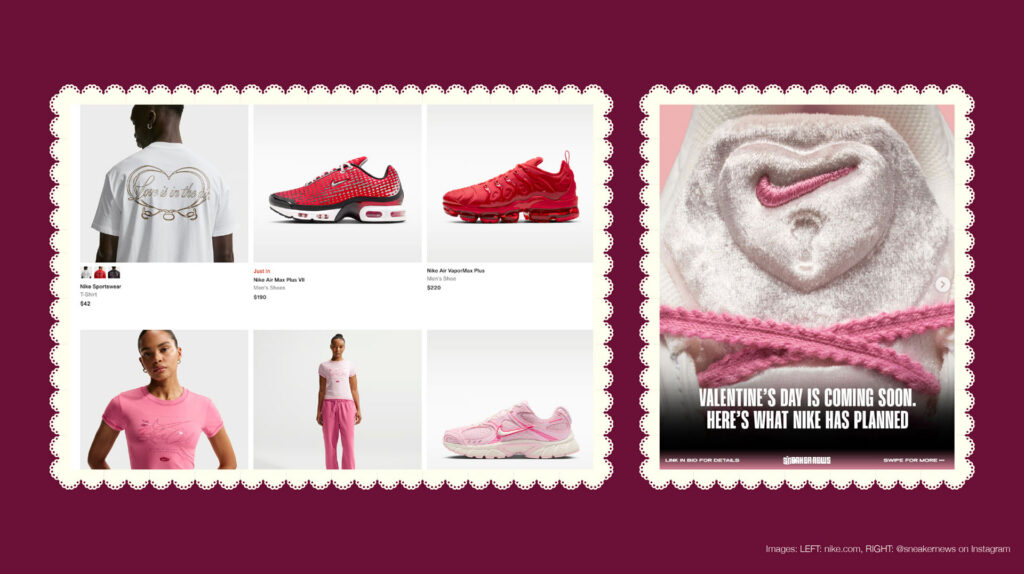
Nike does this through their limited-edition Valentine’s Air Max sneakers decked in pink and red colorways, heart motifs, and “love is in the air” language. If you scroll its social channels, there isn’t a sweeping campaign around Valentine’s Day, but there is a curated selection on its site informed by the brand’s identity. Often, the momentum comes from sneaker culture itself, amplified by niche social accounts rather than a brand-wide Valentine’s push. The product remains grounded in performance and craft. The holiday is present, but it isn’t leading the narrative.
Then there are brands for whom Valentine’s Day isn’t an adaptation, but a natural extension of what they already represent. Venus et Fleur is one of them. Known for its Eternity® Flowers, the brand is already synonymous with beauty, longevity, and luxury. That clarity of identity allows them to amplify on Valentine’s Day and meet their audience in ways that are both meaningful and strategic.
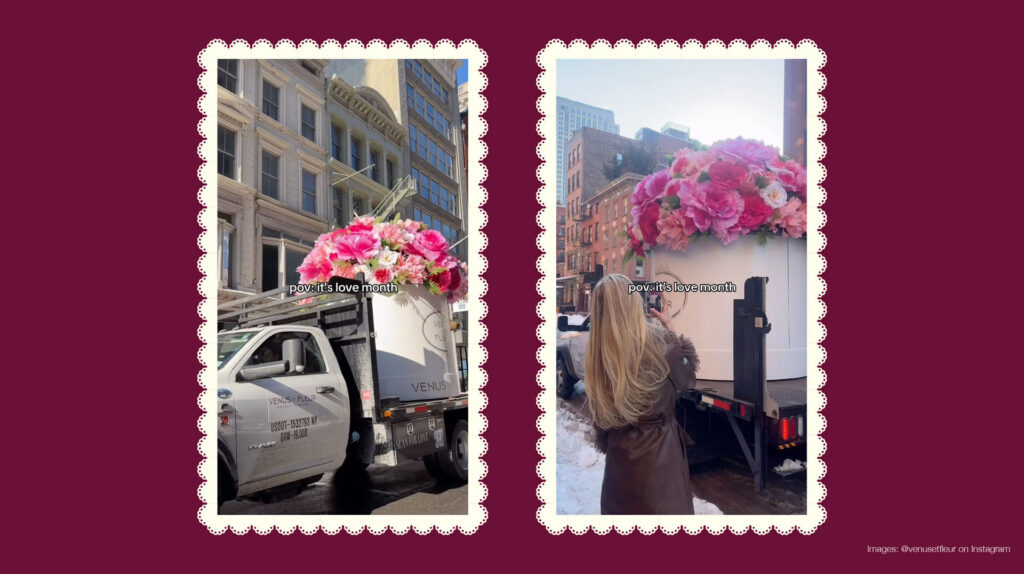
In 2026, that translated into Le Plein, a playful activation built around the grand romantic gesture. A truck carrying an oversized bouquet of the brand’s signature flowers traveled across the country, turning a familiar Valentine’s symbol into a shared cultural moment.
People didn’t just encounter the campaign; they participated in it. Clips were reshared with captions like “the bouquet she wants for Valentine’s Day” or “go outside, there’s a delivery for you.” What began as an in-person activation extended naturally to social, gaining viral traction and reaching audiences beyond the cities on its route.
The oversized flowers were simply a scaled-up expression (literally!) of what the brand already offers: abundance, romance, and florals designed to make a lasting impression. In this case, being part of the cultural conversation mattered just as much as making the sale.
If you’re a brand leader, ask:
- What emotion does our product help someone express?
- What role does our brand play in their story?
- Is that alignment felt by the receiver, or only by our marketing team?
True romantics don’t choose brands because of discounts. They choose them because the brand feels like a natural extension of the care they want to show.
Beyond a One-Day Campaign
Valentine’s Day is, by nature, a spike in attention. Cultivating a meaningful connection amidst the digital landscape is harder. For brands, that means meeting the moment without losing sight of the relationship that began before and continues long after February 14.
Love isn’t meant to peak and disappear. It’s meant to be sustained.
The challenge isn’t whether Valentine’s Day matters. It’s how you show up when it does. The most resonant expressions don’t introduce something new. They reinforce what’s already true.
And that starts with understanding your audience. While both Reese’s and Godiva show up for Valentine’s Day, they market themselves differently by Halloween—Reese’s in trick-or-treat bags for kids, and Godiva with salted caramel chocolates for adults. The product category is the same. The role they play is not. For people, the lesson is similar. The gestures that linger are rarely the biggest ones. They’re the ones that show up consistently.
Valentine’s Day may be filled with candy, cards, and flowers, but at its core, it’s about showing someone what they mean to you. For brands, it’s an opportunity to bridge intention and authentic action.
Through meaningful marketing, companies can shift the question from “Is it too commercial?” to “Does it feel true?”
And if it does, maybe the pink flowers were always okay.